| Drawing upon an organisation with which you are familiar, evaluate the ways in which its digital business model has contributed to its success. 800 words |
Introduction
Looking back at 1978, personal computers, mobile phones, and the Internet were still in their infancy. These powerful disruptive innovations have shaped the society in which we live today, and it has taken decades to make a full impact. Today, technology is changing much faster than ever. As these new technique and business model develop and mature – not only faster, but more profoundly. Enterprises have ushered in another change, the change of digital business model. IBM is a prime example that responding effectively to challenges in the digital economy and achieve results.
By 2019, the official establishment of IBM has been 108 years old. As a technology company with a history of more than a century, it can be said that the history of IBM is a history of human computers. As an enterprise that started with hardware manufacturing, how did IBM adapt to the age of the digital economy, step by step, turning technology into a commodity and digital commerce into a management weapon?
Cognitive Solutions & Cloud Platforms
The Internet bubble burst in 2000; in 2002, Gerstner retired. Since then, IBM has undergone two transformations: one from Smart Earth to CAMSS, and the other is the ongoing digital business model transition – from CAMSS to ‘cognitive solutions + cloud platforms’.
In the first quarter of 2002, IBM’s profits fell sharply, at which time Samuel Palmisano succeeded Gerstner as CEO of IBM. Then, IBM acquired PricewaterhouseCoopers for $ 3.9 billion, and Rational Software for $ 2.1 billion. This gives IBM a variety of back-office services such as consulting, not just IT product services. The move marks IBM’s march from hardware science and technology to the provision of information system services, enterprise management and operational consulting services. While in-depth consulting, software and technical services, IBM has also taken this step to further enhance its global execution capabilities and clarify its high-value business model driven by four wheels of software, hardware, IT services and consulting services (ibm.com).

Samuel Palmisano sold the PC business to China’s Lenovo Group in 2004 and proposed an ‘on demand’ strategy: exit the PC (sell to Lenovo) hardware industry and transform the company to provide customers with integrated service companies from strategic consulting to solutions. As Wharton management Professor Mark J. Zbaracki commented, ‘IBM’s strength has always been good at reinventing itself.’
Smart Earth & AI
By 2006, IBM’s full-year operating revenue after transformation had reached $ 91.4 billion. Three years later, IBM’s revenue reached a further $ 103.6 billion. Samuel Palmisano released their new direction in 2008: global human society transforms complex natural systems into complex business and social systems, and this system is based on a unified intelligent global infrastructure. To this end, IBM launched the well-known ‘Smart Earth’ strategy. The proposal of this strategy can be said to accurately grasp the technological development context of the Internet of Things, cloud computing, big data, and mobile, and point out a new direction for the development of the IT industry. This has led to the development of several industrial chains, such as smart cities, smart healthcare, smart energy, smart transportation, and so on (ibm.com).
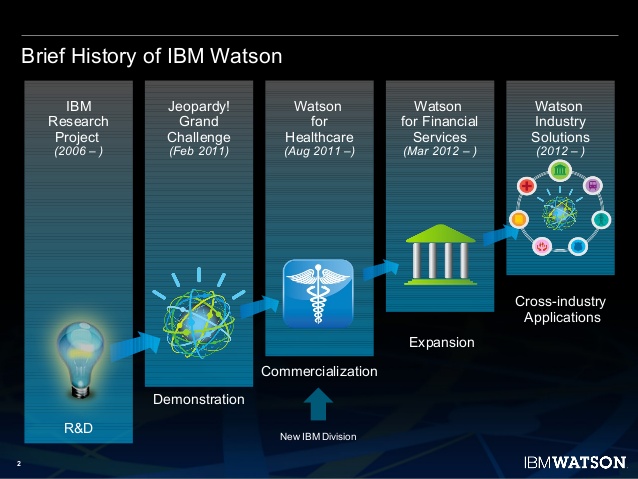
In order to substantially promote the ‘Smart Earth’ strategy, IBM has continuously launched ‘Watson’, the first supercomputer in the history to understand human natural language under the name of founder Old Watson. ‘Watson’ defeated two human champions in the old American quiz TV show ‘Jeopardy!’ And was hailed as a great breakthrough in computer science and artificial intelligence in the 21st century. As a result, the word ‘Artificial Intelligence’ began to enter people’s vision on a large scale.
Cognitive Computing
In 2012, IBM was then the company with the most employees in the United States, with 345,000 employees worldwide. At the same time, Ginni Rometty, who joined IBM for 20 years as a system engineer, began to serve as the company’s chairman, president, and CEO. She is the first female CEO and chairman in IBM history. She took over the banner of her appointment, and the transformation direction is to shift IBM from a traditional hardware, software and services company to a company that provides customers with cognitive solutions and cloud platforms. In her opinion, ‘cognitive computing is the technology that changes everything’ (ibm.com).
IBM is adopting innovative business models and using new digital capabilities to enable unique consumer experiences. The 2013 IBM Global Executive Survey showed that in the past three years, their focus has completely shifted from a business strategy aimed at reducing operating costs to business growth and transformation.
Due to the ongoing digital economy, we are not yet sure whether IBM’s ongoing transformation is completely successful but looking back at IBM’s more than 100 years of history, the company’s classic transformation in times of crisis has strengthened our confidence. So far, IBM should be the smoothest giant in strategic transformation in the IT industry. Each strategic transformation has embraced the trend of the development of the technology industry, thus gaining opportunities and wealth for itself.
Conclusion
The reason why IBM can be that successful is that it not only committed to the development of cutting-edge science and technology, but also well adapted to the digital business model, boldly transforming the entire enterprise from manufacturing to an enterprise that provides advanced technical services. To conclude, digital business has changed from IBM’s products to the survival value of the entire enterprise.
An enterprise is also a life body, with its own life cycle. Throughout the history of IBM, we can stand on the shoulders of the giant and learn the courage, wisdom and vision.

Words count: 873
References
- 8 best practices to optimize your IT to accelerate digital transformation. (2018, May 17). Retrieved from https://www.ibm.com/cloud/yourcloud/8-best-practices-to-optimize-your-IT/?mhsrc=ibmsearch_a&mhq=digital transformation
- IBM study defines a roadmap to advance enterprise mobility. (n.d.). Retrieved from https://www-03.ibm.com/press/us/en/pressrelease/44539.wss
- Walker, L. (2007). IBM business transformation enabled by service-oriented architecture. IBM Systems Journal, 46(4), 651-667.
 Laura's blog