My name is Laura. I am currently a MSc student studying International Business at the University of Exeter.
I studied Accounting as my undergraduate major in Shanghai. I also did internship in finance, auditing, and human resources when I was undergraduate, and I felt that the age of digital economy is coming. One of the talents needed for future business is someone who masters advanced digital business technology and new management method. Through the learning of Digital Business Models, I hope that I can apply my knowledge and skills in my future work in a new way.
Outside of school, I like cooking and playing badminton. Hope to make more friends. Please feel free to make comments and interact with me.
The learning process of this module is really an interesting experience for me.
Learning from multiple channels has broadened my knowledge. Watching the videos on YouTube to find resources cannot be achieved in other courses. However, in this course, video is a good reference resource.
During the learning of this module, I have written two professional blogs. The first blog is about the impact of the digital economy to the HR job role. I combined the experience when I was an HR assistant. In the second blog, I analyzed IBM from the timeline and concluded the reasons why its transformation was so successful.
At the same time, I read, thought and commented on other people’s blogs. For example, in Yiwen’s blog (2020), I learned about the tax industry, and from Shing’s blog (2020), I swam the ocean of entertainment industry. Moreover, when reading other people’s articles, I often tend to pay attention to their writing strengths and weaknesses, and then think about whether I avoid these issues that make my thinking less critical. Sharing with others and exchanging ideas can really have more effect on learning.
It is not realistic for me to learn IT technology now as a business major student, but I can cultivate an attitude of accepting emerging digital technologies. It is because I learned the digital business models that I am able to embrace those ever-changing technologies and this changing world. I think my biggest gain is not only in the model itself, but by learning about digital business models and learning about the existence of those digital technologies, in the future workplace, I can make my choices.
Through the study of this module, I deeply realized that it is very important to master the concepts and technologies of digital business models. Digital technologies not only can be directly used in the IT department of the enterprise to improve productivity, but also the concept of digitalization can be successfully used in the overall positioning if it can be used in the management strategy. For example, the remote interview technique efficient the work of HR. IBM’s managers grasped the position that the computer manufacturing industry needs to convert from hardware to software and even advanced services, and thus pull a sunset condition back to a sunrise status. This kind of thinking is what I hope to continuously cultivate and exercise in my future studies and professional development.
Gain form MOOC Community & My Future Career Plan (YouTube)
Drawing upon an organisation with which you are familiar, evaluate the ways in which its digital business model has contributed to its success. 800 words
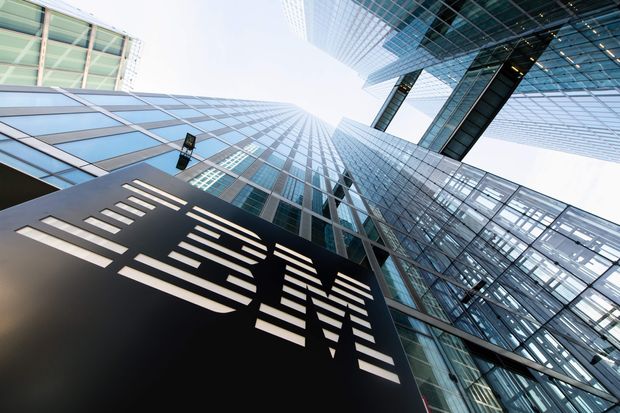
International Business Machines Corporation
Introduction
Looking back at 1978, personal computers, mobile phones, and the Internet were still in their infancy. These powerful disruptive innovations have shaped the society in which we live today, and it has taken decades to make a full impact. Today, technology is changing much faster than ever. As these new technique and business model develop and mature – not only faster, but more profoundly. Enterprises have ushered in another change, the change of digital business model. IBM is a prime example that responding effectively to challenges in the digital economy and achieve results.
By 2019, the official establishment of IBM has been 108 years old. As a technology company with a history of more than a century, it can be said that the history of IBM is a history of human computers. As an enterprise that started with hardware manufacturing, how did IBM adapt to the age of the digital economy, step by step, turning technology into a commodity and digital commerce into a management weapon?
Cognitive Solutions & Cloud Platforms
The Internet bubble burst in 2000; in 2002, Gerstner retired. Since then, IBM has undergone two transformations: one from Smart Earth to CAMSS, and the other is the ongoing digital business model transition – from CAMSS to ‘cognitive solutions + cloud platforms’.
In the first quarter of 2002, IBM’s profits fell sharply, at which time Samuel Palmisano succeeded Gerstner as CEO of IBM. Then, IBM acquired PricewaterhouseCoopers for $ 3.9 billion, and Rational Software for $ 2.1 billion. This gives IBM a variety of back-office services such as consulting, not just IT product services. The move marks IBM’s march from hardware science and technology to the provision of information system services, enterprise management and operational consulting services. While in-depth consulting, software and technical services, IBM has also taken this step to further enhance its global execution capabilities and clarify its high-value business model driven by four wheels of software, hardware, IT services and consulting services (ibm.com).
Samuel Palmisano
Samuel Palmisano sold the PC business to China’s Lenovo Group in 2004 and proposed an ‘on demand’ strategy: exit the PC (sell to Lenovo) hardware industry and transform the company to provide customers with integrated service companies from strategic consulting to solutions. As Wharton management Professor Mark J. Zbaracki commented, ‘IBM’s strength has always been good at reinventing itself.’
Smart Earth & AI
By 2006, IBM’s full-year operating revenue after transformation had reached $ 91.4 billion. Three years later, IBM’s revenue reached a further $ 103.6 billion. Samuel Palmisano released their new direction in 2008: global human society transforms complex natural systems into complex business and social systems, and this system is based on a unified intelligent global infrastructure. To this end, IBM launched the well-known ‘Smart Earth’ strategy. The proposal of this strategy can be said to accurately grasp the technological development context of the Internet of Things, cloud computing, big data, and mobile, and point out a new direction for the development of the IT industry. This has led to the development of several industrial chains, such as smart cities, smart healthcare, smart energy, smart transportation, and so on (ibm.com).
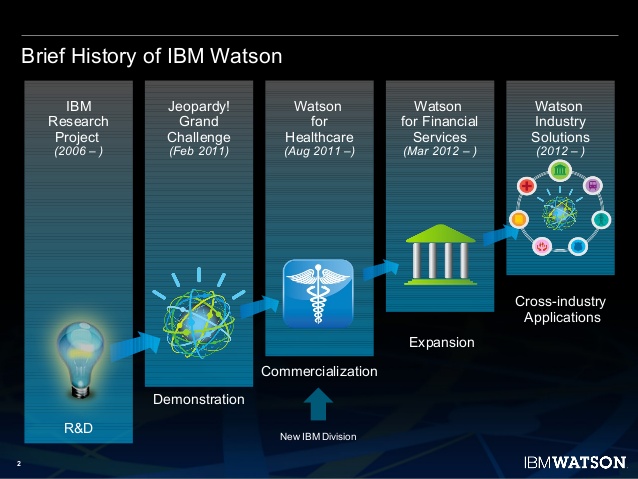
In order to substantially promote the ‘Smart Earth’ strategy, IBM has continuously launched ‘Watson’, the first supercomputer in the history to understand human natural language under the name of founder Old Watson. ‘Watson’ defeated two human champions in the old American quiz TV show ‘Jeopardy!’ And was hailed as a great breakthrough in computer science and artificial intelligence in the 21st century. As a result, the word ‘Artificial Intelligence’ began to enter people’s vision on a large scale.
Watson is a computer question and answer (Q & A) system made by IBM. IBM introduced that ‘it is an application of open question answering technologies such as advanced natural language processing, message retrieval, knowledge representation, automatic reasoning, machine learning, etc.” DeepQA technology developed, analyzed and evaluated’. (wikipedia)
Cognitive Computing
In 2012, IBM was then the company with the most employees in the United States, with 345,000 employees worldwide. At the same time, Ginni Rometty, who joined IBM for 20 years as a system engineer, began to serve as the company’s chairman, president, and CEO. She is the first female CEO and chairman in IBM history. She took over the banner of her appointment, and the transformation direction is to shift IBM from a traditional hardware, software and services company to a company that provides customers with cognitive solutions and cloud platforms. In her opinion, ‘cognitive computing is the technology that changes everything’ (ibm.com).
Ginni Rometty, CEO of IBM, discusses the challenges of leading a 107 year-old company, the impact that AI will have on our society, and why you should have a purpose and a passion for what you do. ‘Being a CEO was never a goal for me. Some people think it needs to be a specific life-long goal – that you really have to want it. I don’t subscribe to that school. Just keep doing what it is you love to do, and that will open doors.’ (YouTube)
IBM is adopting innovative business models and using new digital capabilities to enable unique consumer experiences. The 2013 IBM Global Executive Survey showed that in the past three years, their focus has completely shifted from a business strategy aimed at reducing operating costs to business growth and transformation.
Due to the ongoing digital economy, we are not yet sure whether IBM’s ongoing transformation is completely successful but looking back at IBM’s more than 100 years of history, the company’s classic transformation in times of crisis has strengthened our confidence. So far, IBM should be the smoothest giant in strategic transformation in the IT industry. Each strategic transformation has embraced the trend of the development of the technology industry, thus gaining opportunities and wealth for itself.
Conclusion
The reason why IBM can be that successful is that it not only committed to the development of cutting-edge science and technology, but also well adapted to the digital business model, boldly transforming the entire enterprise from manufacturing to an enterprise that provides advanced technical services. To conclude, digital business has changed from IBM’s products to the survival value of the entire enterprise.
An enterprise is also a life body, with its own life cycle. Throughout the history of IBM, we can stand on the shoulders of the giant and learn the courage, wisdom and vision.
Choose a job role (or career path) with which you are familiar. In what ways has this role 1) already changed in the digital economy, and 2) be likely to change further in the future? 800 words
In the digital economy age, the operating methods and roles of human resources organizations is changing. Today, talent management ever more important in improving in terms of corporate competitiveness, digital human resources organizations will occupy a more advantageous position and play an indispensable role.
To begin with, let me share with you the intuitive part.
During my undergraduate period, I did a half-year human resources assistant internship at the head office of the Bank of Shanghai. During this period, I came into contact with many human resources works in recruitment and personnel file management. I found that although Bank of Shanghai is one of the most popular local banks in Shanghai, many working models are outdated. Talking about the human resources department, there are too many proceeds can be improved. In other words, even an intern felt that many steps were inefficient…Yes, I’m complaining. For example, the HR system is very outdated, and the information need to be updated manually. This job is boring, and mistakes are unavoidable. However, you know, this is a common problem for many companies. Thanks to these powerless feelings at work, I thought a lot.
Bank of Shanghai
No doubt human resources management has made many great improvements in the past ten years. In terms of recruitment, more than a decade ago, companies that wanted to recruit university graduates could only go to campus to open job fairs, collect paper CVs, call interviews by phone, and then schedule time and place for face-to-face interviews. And now, HR have already begun to use a variety of ways to recruit. For example, posting recruitment information on mobile apps, receiving electronic files of CVs, and completing various quality tests online, such as completing Sudoku games, simulating daily tasks in enterprises to test the EQ of job candidates, and even a small number of companies have begun experiments AI testing and then flexible video interviews.
In short, advanced technology has provided HR with the opportunity to test job candidates more comprehensively, and also allows companies to more accurately meet their needs when selecting talent.
Talking about training, too many meetings often make employees feel very boring, leading to less efficient outcomes. Now, through the online lessons on the computer and online fun test questions, you can achieve a very good employee knowledge and skills improvement. In addition, changes in performance management are even more significant for companies.
Furthermore, I want to share my perspective on the digital economy. I think that if a company wants to keep up with the pace of the digital economy, what they need most is not technology, but management. That is to say, the change that the digital economy will bring to the human resources industry in the future is that the talent demand will not only focus on IT talents, but also on management talents.
It is good management models that are likely to keep changing further in human resource department.
HR Trends for 2020. In his annual overview Tom Haak of the HR Trend Institute (https://hrtrendinstitute.com) covers 12 important trends that HR can (should?) take into account.
I have participated in an interview of the position of bank teller. The interviewer told me that counter services are gradually being replaced by AI, and many traditional tellers are facing unemployment. He asked me that after I enter this industry, what is my plan to avoid unemployment. I didn’t have a clear idea of the digital economy at that time. My answer was to become an AI technology background supporter. Now, rethinking of this interview, I have a new answer. What the digital economy needs most is not IT personnel, but managers with digital economy thinking. Digital transformation needs managers with the insight and leadership to co-ordinate this complexity. In my opinion, digital transformation is a management proposition, although it looks more technical than previous management propositions (Betchoo, 2016).
With the gradual maturity of technologies such as cloud computing, AI, big data, and the overall slowdown in the growth of traditional industries, digital transformation is no longer a multiple-choice question, but a survival question. In the context of industrial digital transformation, both enterprises and employees are facing the test of this industry’s digital transformation (Kane, Palmer, Phillips, Kiron, & Buckley, 2015). International data company IDC previously conducted a survey of 2,000 CEOs of multinational companies. The results show that by 2018, 67% of the world’s top 1000 companies regards digital transformation as the strategic core of their enterprises. Unfortunately, the failure rate of traditional enterprises’ digital transformation has still hovered between 70% and 80%.
Investigating the reasons for the failure of these traditional enterprises’ digital transformation, it is not difficult to find that many traditional business leaders hope to achieve rapid growth or even double their turnover through digital transformation. When they find that this goal cannot be achieved, they retreat to digital implementation Head of IT department. However, the practical experience of successful digital transformation enterprises proves that the digital transformation of enterprises should be driven by managers and driven from the top down (Ustundag & Cevikcan, 2017). Enterprise digital transformation is not so much a technical issue as it is a management issue.
I am willing that you leave your opinions or any questions and let’s discuss them together to make the point more thorough. ^_^
Words count: 854
References
Betchoo, N. K. (2016, August). Digital transformation and its impact on human resource management: A case analysis of two unrelated businesses in the Mauritian public service. In 2016 IEEE International Conference on Emerging Technologies and Innovative Business Practices for the Transformation of Societies (EmergiTech) (pp. 147-152). IEEE.
Kane, G. C., Palmer, D., Phillips, A. N., Kiron, D., & Buckley, N. (2015). Strategy, not technology, drives digital transformation. MIT Sloan Management Review and Deloitte University Press, 14(1-25).
Ustundag, A., & Cevikcan, E. (2017). Industry 4.0: managing the digital transformation. Springer.








 Laura's blog